Uga High School Programs
Middle and high school teachers and administrators are invited to request an ASPIRE Day campus visit. During ASPIRE Days, visiting groups are welcomed onto UGA's Athens campus for a modularized mentorship and STEM exposure experience designed to facilitate progress on student projects, equip students with enhanced knowledge and skills specific to their areas of interest, inspire students through exposure to state-of-the-art research facilities and speakers, and promote further exploration of STEM career paths and self-esteem in STEM disciplines. Drawing from time-tested mentorship models developed by some of the nation's leading authorities in scientific teaching (;;;; ), these early iterations of the ASPIRE program match middle and high school students preparing projects for local, regional, state, national, and international STEM fairs and competitions with advanced upperclassmen undergraduates, graduate students, professionals, and faculty mentors. Mentors are chosen through an application-based process. Their major areas, research programs, areas of specialization, and mentorship experience are considered when matching mentors to mentees. Mentor contact information will be provided to teachers and students during campus visits in order to foster continued mentorship activity; teachers and students may arrange further correspondence in this way, and the ASPIRE Program will subsidize any costs mentors incur to visit middle and high schools to continue their mentorship activity.
Build Make a direct impact on a student's education. Mentorship programs like ASPIRE have been demonstrated to foster participation in STEM fields both while in school and once in the workforce.
Not only has mentorship been associated with higher GPA's, SAT scores, and graduation rates; it has been shown to narrow the achievement gap between groups of students with unequal access to resources, foster goal-setting behaviors, and strengthen self-esteem in math and science. M entorship empowers and emboldens students. Illuminate The ASPIRE Outreach Program engages middle and high school students at Title I public schools in project-based mentorship, connecting educators and students in underserved and underrepresented communities with UGA student and faculty mentors. By building bridges between UGA and high-achieving students in underprivileged and/or underrepresented areas, we plant the seeds of UGA's bright future.
We are so committed to this idea that we will subsidize trips to schools so you can continue mentoring students even after they visit campus. By fanning the flames, we can illuminate our community.
UGA MathCamp: Coming July 9-13, 2018 Higher math for high school students. Sign up now for MathCamp 2018: What and Who At MathCamp, UGA faculty mentors each work with a graduate student helper and undergraduate helper guiding a group of roughly 5 high school students on exploratory projects in a range of topics. We plan to have 5 or 6 groups, for a total of 25-30 students. Registration will be on a first come first served basis. Topics vary year to year, but in the past they have included topology, graph theory, number theory, cryptography, mathematical problem solving, and mathematical biology. Activities are aimed at high school students entering grades 9-12. However some younger students have also done quite well with the material in the past.

With this in mind, there are no formal grade level requirements. The most important prerequisite is an interest in learning new things and curiosity about mathematics! When and Where We plan to hold camp July 9-13, 2018, in the Boyd Graduate Studies Research Building (200 D.W. Brooks Drive), at the University of Georgia Athens Campus. How MathCamp is funded by, and we are grateful for the additional support provided this year by the UGA Mathematics Department, which will supply us with snacks and t-shirts. There is no cost to participate in MathCamp. Participants have the option of either bringing their own bag lunch, or ordering from Jimmy John's or a similar local restaurant (we'll coordinate a daily order from Jimmy John's each morning, for those who are interested).
Uga Pre College Summer Program
Topics for 2018. Monster Epidemiology. Combinatorial Geometry.
Geometry and Gerrymandering. Matrices and Curves on Surfaces.
What Numbers Could Not Be. Colored Webs Details Project: Monster Epidemiology (Faculty Co-ordinator: ) Project: Combinatorial Geometry (Faculty Co-ordinator: ) Combinatorics is the art of (sophisticated) counting. Can it be applied to questions in geometry? One can make a living by doing so. Want to begin to see how? Project: Geometry and Gerrymandering (Faculty Co-ordinator: ) Project: Matrices and Curves on Surfaces (Faculty Co-ordinator: ) This project is about finding all the ways that you can draw three green non-self-intersecting curves on a surface, intersecting 3 given red and blue curves, so that when you follow some interesting instructions to turn this diagram into a 3-by-3 matrix (grid of 9 numbers), the matrix has some special properties, which you'll learn about.
So we'll learn about matrices, determinants of matrices, how matrices come from intersections of different colored curves, and we'll be searching for some interesting examples that may or may not exist. Maybe we'll find them, or maybe we'll learn why they can't exist. Lots of doodling, and playing around with numbers, and experimenting.
Project: What Numbers Could Not Be (Faculty Co-ordinator: ) Logic includes a study of argumentation within natural language, consistent reasoning, valid argumentation, and errors in reasoning. In this project we will use propositional logic to evaluate the validity of deductive arguments and the consistency of statements to answer the question, “Do numbers exist?” and determine what numbers could NOT be. Project: Colored Webs (Faculty Co-ordinator: ). Schedule and Daily Logistics 2018 All rooms listed below are located in the Boyd Graduate Studies Building on UGA Campus.
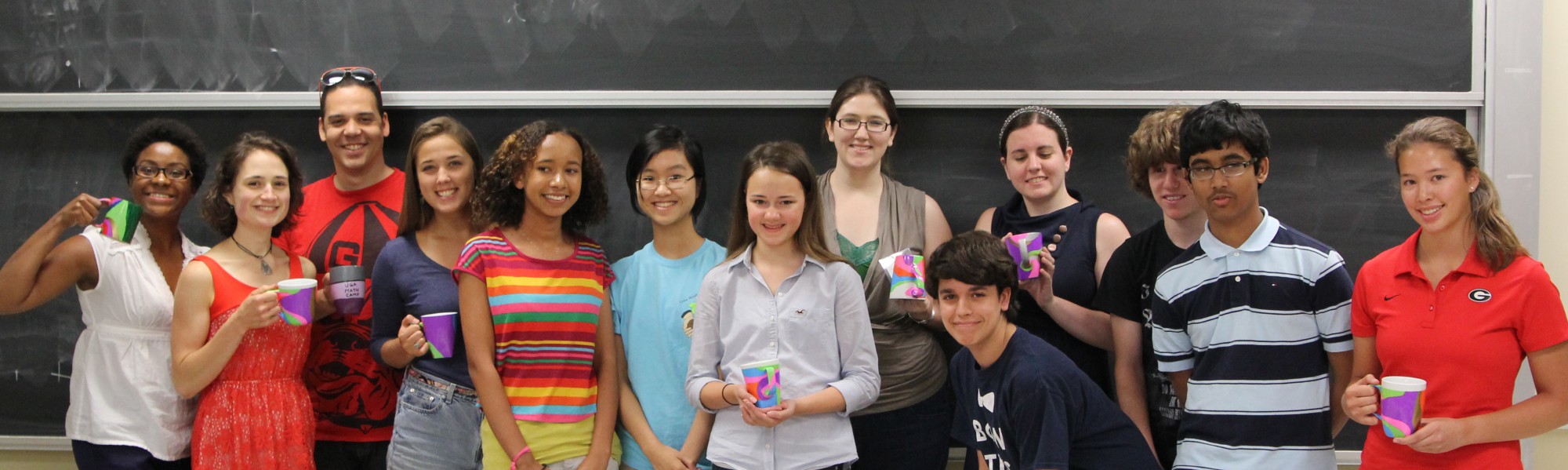
Snacks will be provided in the Matrix (Room 308). Participants should either bring their own packed lunch (there is a refrigerator available), or sandwiches can be ordered from Jimmy Johns for delivery (students should bring cash for this). We will take orders for the group each morning. MathCamp 2016 MathCamp 2016 ran Monday, June 6 to Friday, June 10, in the Boyd Graduate Studies Research Building (200 D.W. Brooks Drive), at the University of Georgia Athens Campus.
Our 2016 program featured activity groups led by, and Amber Russell. You can see what they did below:: Braids (Led. Assistants: and Justin Johnson) Can you put a closed rope a round the strands at the top of a braid such that it will have a specific shape when it falls down to the bottom of the braid? Through hands-on activities and guided learning, students will develop mathematical tools to solve this puzzle.
Adult High School Programs
Along the way they will discover that both braids and curves are mathematical objects, and find a way to describe these objects and their interaction using algebraic notation. Monster Epidemiology: Zombies, Vampires, and Werewolves (Led.
Assistants: and Elesha Coons) In this workshop we will produce mathematical models to predict the outcome of an encounter between a healthy human population (for example, the town of Watkinsville) and a few mythical creatures. We will study: (a) humans vs. One zombie, (b) humans vs. One vampire, and (c) humans vs. A competition between several vampires and several werewolves and any other apocalyptic scenario participants can come up with. Not only students will learn how to predict who wins, but also what are the best strategies to contain these mythical monsters. The mathematical tools used in this workshop belong to the same family of models used to guide public health policies against a number of diseases.

We will use Scilab, an open source mathematical package, to explore the mathematical models needed in the study of monster epidemiology. Symmetries of two-dimensional repetitive patterns (Led. Assistants: and Susanna Conine-Nakano) The two-dimensional plane can be with repetitions of some shapes without gaps or overlaps to create mosaic-like patterns.
Artists like MC Escher have studied the symmetries of this patterns to create stunning works of art. We will explore the mathematics behind this patterns and we will create our own beautiful designs! Assistants: and Jadzia Dax Hutchings) We will explore several solved and unsolved problems about the set of prime numbers, ranging from classical results known to Euclid in 300 BCE to spectacular advances from just the past few years.
Discovering Graph Theory (Led by Amber Russell. Assistants: and Carson Aft) Through a series of guided learning projects and hands-on activities, students will discover the basic definitions and some famous results from the field of Graph Theory. Specific topics include planar graphs, graph embeddings on surfaces, and the Four Color Theorem.